
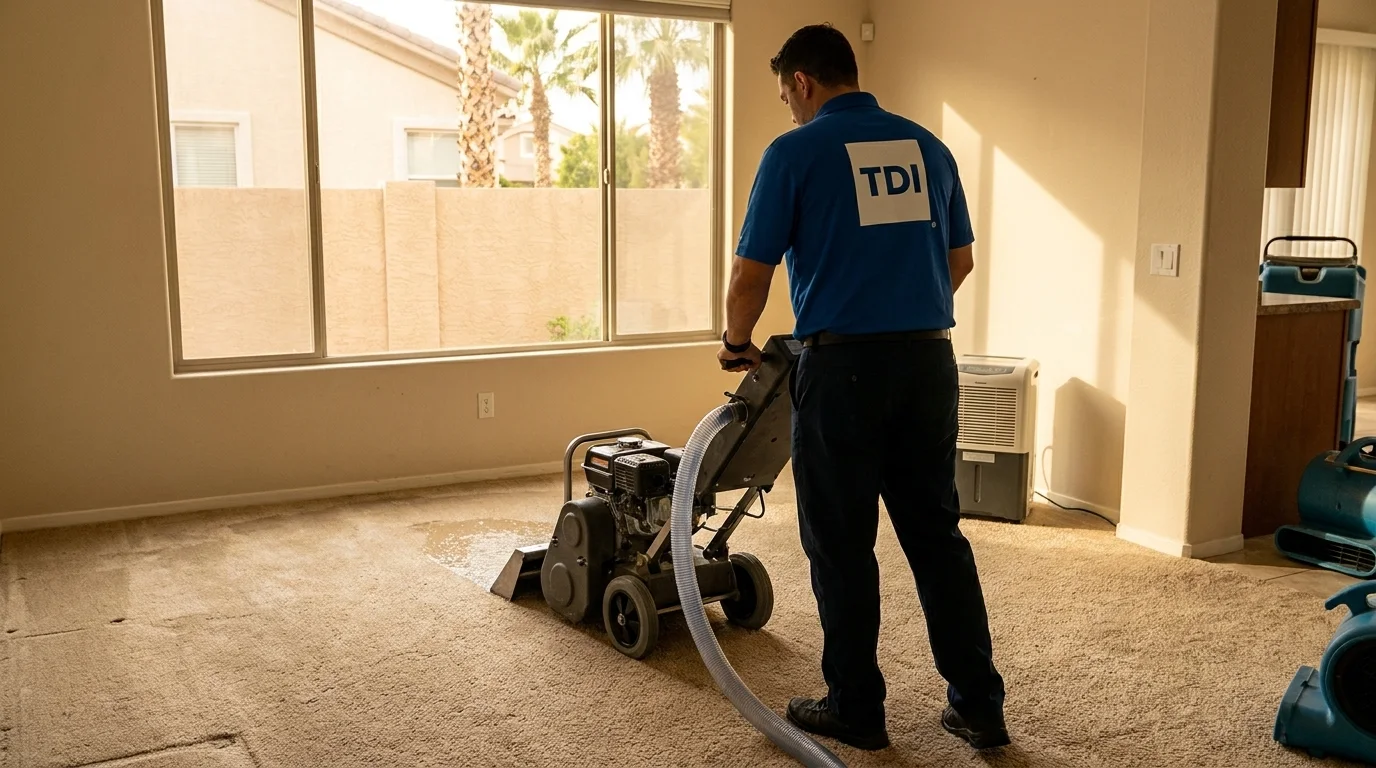
Carpet Water Extraction in Sacramento
Trusted carpet water extraction in Sacramento and surrounding areas. Licensed general contractor, free estimates, on-time and on-budget. Call (877) 688-0866.
Carpet that still squishes underfoot two or three days after a supply line leak or appliance overflow isn’t drying on its own, it’s wicking water sideways into the pad and holding it there. By that point the surface may look fine while the backing stays saturated, and the clock on mold colonization is already running. Carpet water extraction is the step that pulls bound water out of the fiber, pad, and subfloor before it turns into a bigger tear-out job.
What Carpet Water Extraction actually involves
This isn’t a wet-vac pass with a shop vacuum. Proper carpet water extraction uses truck-mounted or portable extraction units capable of pulling water from the fiber, the pad underneath, and in many cases through the carpet backing itself. Depending on how long the water sat and what category it falls under, the pad may need to come out entirely rather than be dried in place, since saturated foam pad rarely returns to its original cushioning or stays sanitary. Once standing and bound water is removed, the remaining job is structural drying: getting airflow and controlled humidity to the carpet, pad, and subfloor until moisture readings return to a dry standard, not just until the carpet feels dry to the touch. On a straightforward single-room loss this can run a few days; multi-room losses with pad replacement or subfloor involvement take longer.
Our process
- Moisture mapping. We check the carpet, pad, and subfloor with penetrating and non-penetrating meters to find out how far the water traveled, not just where it’s visible.
- Extraction passes. Truck-mounted or portable equipment pulls water from the carpet face and, where accessible, through the backing and pad in repeated passes until extraction yields drop off.
- Pad evaluation. Saturated pad is assessed for salvageability. In most Category 2 or 3 losses, and in many Category 1 losses where saturation was prolonged, the pad is removed rather than dried in place.
- Airflow setup. Carpet is floated or lifted at the edges so air can move directly across the subfloor, with air movers and dehumidifiers placed to target the wettest zones first.
- Monitoring and documentation. We return to log moisture readings over the following days until the material reaches a dry standard, giving you and your carrier a record of the process, not just a before-and-after photo.
What separates a good Carpet Water Extraction response from a bad one
The most common mistake is treating the visible carpet as the job and stopping there. Water travels under tack strip, along baseboards, and into the subfloor, and if that moisture isn’t mapped and dried, you end up with delamination, odor, or mold growth weeks later under carpet that looks and feels dry. A second mistake is drying pad in place when it should have been removed, which traps contamination and shortens the life of both the pad and the carpet above it. Insurance adjusters generally want to see moisture logs with daily readings, documentation of the water category, and a clear record of what was removed versus dried in place, so a response that skips documentation often creates friction during the claim even when the physical work was done correctly.
What does Carpet Water Extraction cost?
Costs vary with the size of the affected area, the water category, and whether the pad or subfloor needs attention, so every loss gets a written scope before work begins rather than a flat quote. Homeowners insurance typically covers carpet water extraction when the loss is sudden and accidental, such as a burst pipe or appliance failure, though coverage for the carpet replacement itself can depend on your policy and the water category involved. The ranges below reflect typical industry costs, not a TDI Builders price list.
| Scenario | Typical range |
|---|---|
| Single room, clean water, carpet salvageable | $300 - $900 |
| Single room with pad replacement | $600 - $1,500 |
| Multiple rooms, clean to gray water | $1,200 - $3,500 |
| Whole floor, Category 2 water with pad removal | $3,000 - $7,000 |
| Carpet and pad removal, no salvage, disposal included | $1,500 - $4,000 |
| Extraction plus subfloor drying | $2,500 - $6,000+ |
Seasonal & regional considerations
Sacramento’s wet season runs roughly November through March, and that’s when we see the most carpet saturation calls tied to roof leaks, window intrusion, and slab-level seepage in older homes. In summer, Valley heat can actually work against fast drying indoors if a home is closed up with the AC running low, since air conditioning dehumidifies slowly compared to dedicated drying equipment. Homes on raised foundations around the older grid neighborhoods dry differently than slab homes in newer subdivisions, which is part of why moisture mapping matters before anyone sets up equipment.
Service area
We handle carpet water extraction across Sacramento and into Elk Grove, Roseville, Folsom, Davis, and the surrounding communities, working around each area’s mix of older raised-foundation homes and newer slab construction.
If your carpet is still damp, discolored, or starting to smell after a leak or overflow, don’t wait for it to dry on its own. Call (877) 688-0866 to schedule a moisture assessment and get extraction equipment on-site before the water spreads further into the pad and subfloor.
Frequently Asked Questions
Does homeowners insurance cover carpet water extraction?
Can wet carpet always be saved, or does it need to be replaced?
Why does the pad usually need to be replaced even if the carpet can be saved?
How long does it take for carpet and pad to dry after extraction?
What happens if water has already reached the subfloor under the carpet?
Looking for the best carpet water extraction company in Sacramento?
TDI Builders provides carpet water extraction in Sacramento, CA and the surrounding area, and has served local property owners since 1983. Customers rate us 5.0 out of 5 stars across 9 Google reviews. We answer calls 24/7 — call (877) 688-0866 for immediate help.
Need Carpet Water Extraction now?
We respond 24/7 across Sacramento and surrounding CA cities.
Related Coverage
- Our Construction Services
- Contact TDI Builders
- Carpet Water Extraction in Antelope
- Carpet Water Extraction in Arden-Arcade
- Carpet Water Extraction in Carmichael
- Carpet Water Extraction in Citrus Heights
- Carpet Water Extraction in Davis
- Carpet Water Extraction in El Dorado Hills
- Carpet Water Extraction in Elk Grove
- Carpet Water Extraction in Elverta
- Carpet Water Extraction in Fair Oaks
- Carpet Water Extraction in Florin
- Carpet Water Extraction in Folsom
- Carpet Water Extraction in Foothill Farms