
Fire and Smoke Damage Rebuilding in Sacramento
Trusted fire and smoke damage rebuilding in Sacramento and surrounding areas. Licensed general contractor, free estimates, on-time and on-budget. Call (877) 688-0866.
Smoke doesn’t stop at the burn line. After a fire, soot migrates through HVAC ducts, settles into wall cavities, and bonds to surfaces in rooms the flames never touched, and the odor that seems to fade in the first week often resurfaces months later when humidity rises. Rebuilding after a fire means more than replacing what burned. It means finding every surface that absorbed combustion byproducts, treating them correctly, and reconstructing the structure so it’s safe, code-compliant, and livable again.
What fire and smoke damage rebuilding actually involves
Fire losses fall into two overlapping problems: the physical destruction from heat and flame, and the chemical contamination left by smoke. Both have to be resolved before reconstruction begins, and the contamination side is where most corners get cut.
Soot comes in different forms depending on what burned. Protein soot from kitchen fires is nearly invisible but leaves a pungent, greasy film that ordinary cleaning spreads rather than removes. Synthetic soot from burning plastics, wiring insulation, or composite materials is oily, acidic, and corrosive, it will continue etching metal fixtures and discoloring surfaces if it isn’t neutralized. Wet soot from a fire that was suppressed quickly with water has its own chemistry. Each type requires a different cleaning agent and technique.
Beyond soot, structural assessment after a fire looks at char depth in framing members, whether engineered lumber (LVL beams, OSB sheathing, I-joists) has delaminated or lost load capacity, and whether masonry or concrete has spalled from thermal shock. Electrical systems in fire-affected zones are treated as compromised until inspected, because heat degrades wire insulation even when the wires themselves don’t ignite.
Timeline from loss to move-back varies with the scope of damage. A single-room fire with contained smoke spread might be resolved in three to six weeks. A whole-floor or whole-structure loss with full gut-and-rebuild typically runs three to six months, depending on permit lead times and material availability.
Our process
-
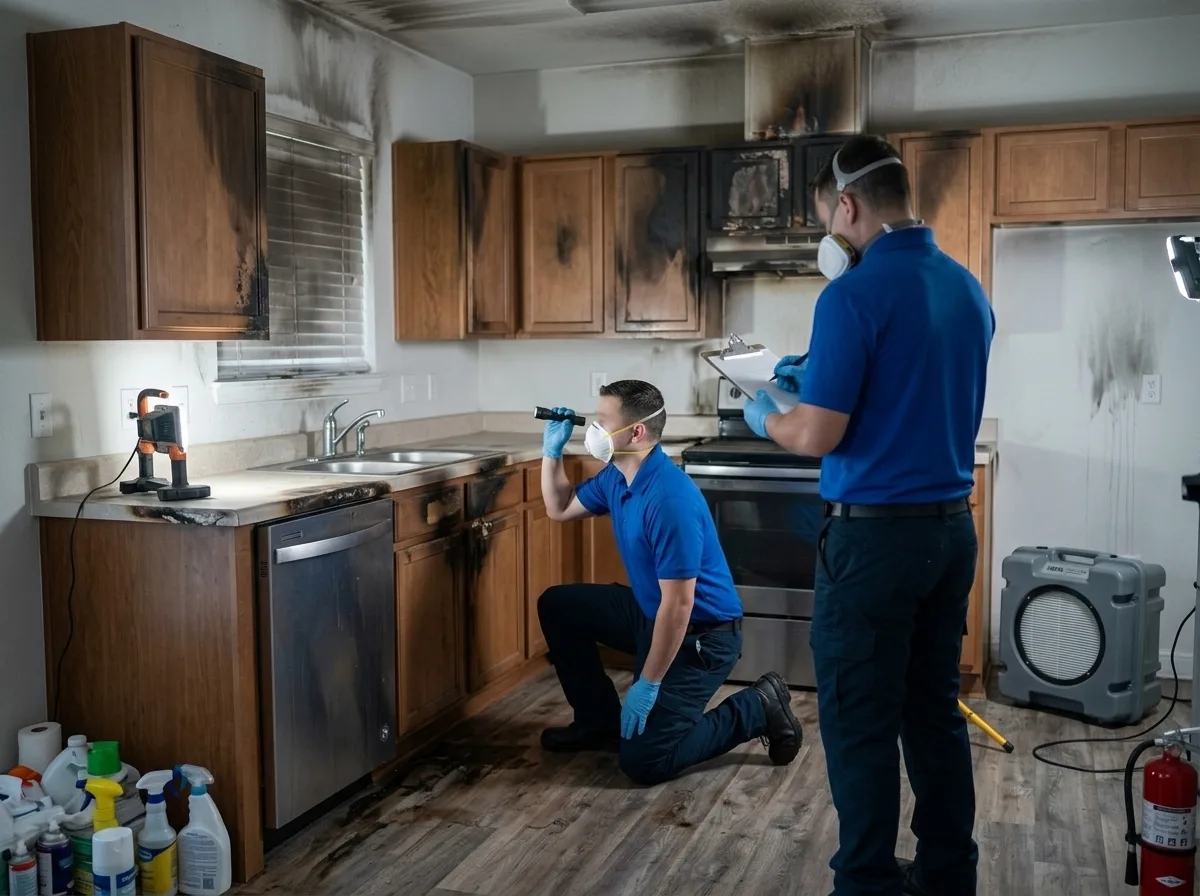
Damage assessment and soot characterization. Before any cleaning or demolition begins, the affected area is documented, photographs, moisture readings, air quality samples where indicated, and the type of soot present is identified. This determines which cleaning protocols apply and informs the written scope of work.
-
Contents pack-out and protection. Salvageable contents are inventoried and removed to a clean staging area before demolition dust and cleaning agents can cause secondary damage. Items that can be restored are catalogued; items that cannot are documented for the insurance claim.
-
Controlled demolition and structural evaluation. Charred and smoke-saturated materials, drywall, insulation, flooring, cabinetry, are removed to the extent the damage requires. Structural framing is evaluated for char depth and load integrity. Any framing that has lost more than a code-allowable margin of its cross-section is flagged for replacement.
-
Smoke and odor treatment. Exposed framing and structural surfaces are cleaned and sealed with an appropriate encapsulant. Thermal fogging or ozone treatment is used to neutralize odor molecules that have penetrated porous materials. HVAC ducts serving the affected zone are cleaned and inspected, smoke travels through ductwork and will re-contaminate a rebuilt space if the system isn’t addressed.
-
Reconstruction and finish work. Once the structure is clean, dry, and inspected, rebuilding begins: framing repairs, insulation, drywall, electrical and plumbing rough-in, and all finish trades. Work is permitted and inspected per Sacramento-area building department requirements. The goal is a finished space that matches or improves on the pre-loss condition.
What separates a good fire damage response from a bad one
The most common failure in fire damage rebuilding is treating it like a cosmetic project. Painting over smoke-stained drywall without cleaning and sealing the substrate first traps odor that bleeds back through the new paint within months. Replacing flooring without addressing smoke penetration in the subfloor leaves the same problem one layer down.
A second common mistake is incomplete duct cleaning. Smoke aerosols are small enough to travel the entire duct system during a fire, and a contractor who only cleans the rooms that burned is leaving contamination in the system.
Insurance adjusters on fire claims look for documentation of soot type and cleaning method, because the appropriate method varies and the cost difference is significant. A scope that just says “clean affected surfaces” without specifying the protocol will often be underpaid. Detailed, method-specific documentation, what was cleaned, with what agent, to what standard, protects the claim.
With 40+ years of construction and rebuilding experience, TDI USA is licensed, insured, and works across commercial, industrial, and residential fire losses throughout the Sacramento region.
What does fire and smoke damage rebuilding cost?
Typical costs for fire and smoke damage rebuilding vary widely based on the size of the affected area, the type of soot involved, and how much structural work is required. Most homeowners find that costs fall somewhere in the ranges below, these are industry-typical figures, not quotes.
| Scenario | Typical range |
|---|---|
| Single room, surface smoke damage only | $3,000 – $8,000 |
| Single room with partial structural rebuild | $8,000 – $20,000 |
| Multi-room smoke spread, limited fire damage | $15,000 – $40,000 |
| Full floor or kitchen fire with rebuild | $40,000 – $90,000 |
| Whole-structure fire, gut and rebuild | $100,000 – $300,000+ |
Every fire loss is different, and TDI USA provides a written scope of work before any work begins so there are no surprises. Homeowners insurance typically covers fire and smoke damage rebuilding, including contents pack-out and odor remediation, subject to your policy’s deductible and coverage limits.
Seasonal and regional considerations
Sacramento’s dry summers and the surrounding foothill communities face elevated wildfire risk from June through October, and the smoke from regional fires, even fires that don’t directly threaten a structure, can deposit fine particulate inside homes through gaps in the building envelope. After a nearby wildfire event, HVAC filters and attic spaces are worth inspecting even if the structure itself was never threatened. The Valley’s low humidity in summer can cause smoke-damaged wood to check and crack more rapidly than in wetter climates, which affects how quickly structural assessment needs to happen after a loss.
Service area
TDI USA serves Sacramento and the surrounding region, including Elk Grove, Roseville, Folsom, Rancho Cordova, West Sacramento, Davis, Woodland, and communities throughout the Sacramento Valley and Sierra foothills. City-specific pages detail local permit contacts and considerations for each area.
If you’re standing in a smoke-damaged home trying to figure out where to start, call (877) 688-0866. TDI USA is available 24/7, we’ll walk you through the immediate steps and schedule a damage assessment so the rebuilding process can begin.
Frequently Asked Questions
Does homeowners insurance cover fire and smoke damage rebuilding?
What's the difference between protein soot and synthetic soot, and why does cleanup vary?
Can smoke odor come back after a home has been cleaned and repainted?
Do I need a building permit to rebuild after a house fire in Sacramento?
How do I know if fire-damaged framing needs to be replaced or can be kept?
Looking for the best fire and smoke damage rebuilding company in Sacramento?
TDI USA, Inc. provides fire and smoke damage rebuilding in Sacramento, CA and the surrounding area, and has served local property owners since 1985. Customers rate us 5.0 out of 5 stars across 9 Google reviews. We answer calls 24/7 — call (877) 688-0866 for immediate help.
Need Fire and Smoke Damage Rebuilding now?
We respond 24/7 across Sacramento and surrounding CA cities.
Related Coverage
- Our Construction Services
- Contact TDI USA, Inc.
- Fire and Smoke Damage Rebuilding in Carmichael
- Fire and Smoke Damage Rebuilding in Citrus Heights
- Fire and Smoke Damage Rebuilding in El Dorado Hills
- Fire and Smoke Damage Rebuilding in Elk Grove
- Fire and Smoke Damage Rebuilding in Fair Oaks
- Fire and Smoke Damage Rebuilding in Folsom
- Fire and Smoke Damage Rebuilding in Granite Bay
- Fire and Smoke Damage Rebuilding in Lincoln
- Fire and Smoke Damage Rebuilding in Loomis
- Fire and Smoke Damage Rebuilding in Modesto
- Fire and Smoke Damage Rebuilding in Rancho Cordova
- Fire and Smoke Damage Rebuilding in Rocklin