
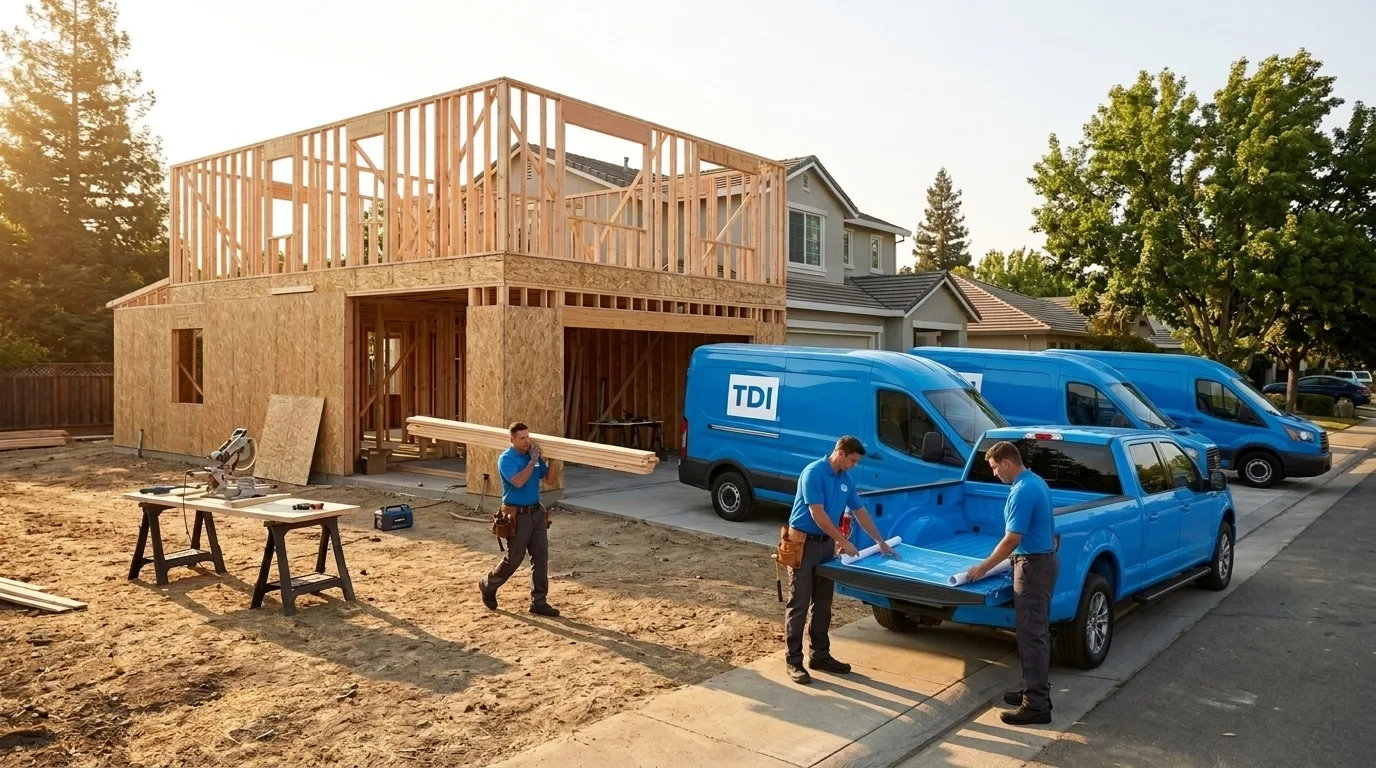
TL;DR: General contractors in California charge either a percentage of total project cost (typically 10-20%) or a fixed fee built into a lump-sum bid. For remodels in the Sacramento region, expect $100-$175 per square foot for standard work and $175-$250+ for high-end finishes or structural changes. The percentage model is most common on larger projects. What moves the number most: whether the work is structural, what finish level you choose, and how many permits the job requires.
If you’re comparing bids on a kitchen gut, a room addition, or a full home remodel and the numbers are thousands of dollars apart, the gap usually isn’t profit margin. It’s scope. One contractor priced the electrical panel upgrade. Another didn’t. One included the permit fees. Another listed them as an allowance. Before you pick the lowest number, you need to understand what’s actually in each bid. This post breaks down how general contractors price work in California, what a realistic range looks like by project type, and what questions to ask before you sign.
How do general contractors charge for their work?
General contractors use one of three pricing structures: a percentage of total project cost, a fixed lump-sum price, or cost-plus (actual costs plus a markup). The percentage model is the most common on mid-to-large projects in California, typically running 10-20% of the total build cost. On a $150,000 remodel, that’s $15,000-$30,000 for the GC’s coordination, overhead, and profit.
On smaller projects, most contractors build their fee into a lump-sum bid rather than quoting a separate line item. You’ll see one number that covers labor, materials, subcontractors, and the GC’s margin. This isn’t hiding anything. It’s just how the industry works at the residential scale.
Cost-plus contracts are less common but do appear on custom new construction and complex insurance rebuilds. The owner pays actual costs as they’re incurred, plus an agreed markup (often 15-20%). This structure gives you full transparency on costs but requires more owner involvement and carries budget risk if the project scope grows.
The California Contractors State License Board requires that any contract over $500 be written, and contracts over $1,000 must include a specific set of disclosures. Before you sign anything, verify your contractor’s license status on the CSLB license check tool.
What does a general contractor cost by project type?
The table below reflects realistic installed costs for the Sacramento metro area in 2026. These numbers include the GC’s fee, labor, and materials at mid-grade finish levels. High-end finishes, structural changes, or significant permit requirements push costs toward the upper end or beyond.
| Project Type | Typical Range | Notes |
|---|---|---|
| Kitchen remodel (full gut) | $40,000-$100,000+ | Cabinets and appliances drive the range |
| Bathroom remodel | $15,000-$45,000 | Primary bath with tile work at the higher end |
| Room addition (400-600 sq ft) | $80,000-$160,000 | Foundation, framing, MEP, finishes included |
| Full home remodel | $100-$175/sq ft | Standard finishes, no structural changes |
| Full home remodel (high-end) | $175-$250+/sq ft | Custom finishes, structural, ADU-adjacent |
| Fire or smoke damage rebuild | Varies widely | Scope driven by insurance adjuster’s estimate |
| Garage conversion to ADU | $60,000-$120,000 | Depends on plumbing, HVAC, finish level |
These ranges assume a licensed general contractor managing subcontractors for electrical, plumbing, HVAC, and finish trades. If a bid comes in dramatically below these numbers, ask which trades are included and whether permit fees are in the price or billed separately.
For a detailed look at kitchen project costs specifically, see our kitchen remodel cost breakdown.
What makes a general contractor’s bid go up?
Five factors move the number more than anything else.
Structural work. Any time a wall comes out, a beam goes in, or a foundation is modified, costs jump. Engineering drawings, structural calculations, and inspections add time and money. A non-structural kitchen remodel and a kitchen remodel that opens a load-bearing wall to the living room are priced completely differently.
Permit requirements. In California, permits are required for most work beyond cosmetic updates. Permit fees in Sacramento County typically run $1,500-$8,000+ depending on project valuation, and the permitting timeline adds weeks to the schedule. A contractor who says “we can skip the permit” is creating a liability for you at resale and with your homeowner’s insurance. Our post on home project permits covers what triggers a permit requirement in detail.
Finish level. The difference between builder-grade cabinets and semi-custom cabinetry is $10,000-$30,000 on a standard kitchen. The difference between standard tile and large-format porcelain with a heated floor is another $5,000-$15,000. Finish selections are the single biggest lever you control on project cost.
Site conditions. Older homes in Sacramento’s established neighborhoods (think Curtis Park, Land Park, or Arden-Arcade) often have deferred maintenance items that surface once walls open: outdated wiring, galvanized plumbing, subfloor rot, or asbestos-containing materials. A good contractor will include a contingency allowance (typically 10-15% of project cost) for unknowns. If a bid has no contingency, ask why.
Subcontractor availability. Labor markets in the Sacramento region have been tight. Electrical and HVAC subs in particular book out weeks in advance. A GC with established trade relationships can schedule more predictably than one who’s calling around for whoever is available.
What is and isn’t included in a general contractor’s bid?
This is where bids diverge most. Before you compare numbers, confirm each bid answers these questions the same way.
Typically included in a lump-sum GC bid:
- All labor for the GC’s direct crew
- Subcontractor costs (electrical, plumbing, HVAC, tile, drywall)
- Materials at the specified grade
- Project management and coordination
- Jobsite cleanup and debris removal
- General liability and workers’ compensation insurance
Often excluded or listed as allowances:
- Permit and inspection fees (sometimes billed at cost)
- Architect or structural engineer fees
- Material upgrades beyond the specified allowance
- Utility connection fees
- Landscaping or exterior work beyond the project boundary
- Furniture, window treatments, or finish items the owner supplies
Allowances are a common source of budget surprises. A bid might include a $3,000 allowance for plumbing fixtures. If you want the fixtures you actually want, that allowance might not be enough. Get specifics on every allowance line before you sign.
For a full list of questions to ask before signing, see our post on questions to ask a contractor before signing a construction contract.
How long does a home remodel take in California?
Timeline depends on project size, permit turnaround, and subcontractor scheduling. Here are realistic ranges for the Sacramento area.
| Project | Typical Timeline |
|---|---|
| Bathroom remodel | 3-6 weeks |
| Kitchen remodel (full gut) | 6-12 weeks |
| Room addition | 3-6 months |
| Full home remodel | 4-9 months |
| Fire damage rebuild | 6-18 months (insurance process adds time) |
Permit review in Sacramento County currently runs 4-10 weeks for residential projects, depending on complexity. That time is before a single tool touches the house. Factor it into your planning, especially if you’re working around a lease end date or a school year.
How do you get an accurate bid?
Getting an accurate number starts before you call a contractor. The more defined your scope, the more accurate the bid. A contractor asked to price “a kitchen remodel” will either give you a very wide range or make assumptions that may not match what you want.
Before you request bids, put together a basic scope document: square footage affected, what’s staying and what’s coming out, your finish level preferences (standard, mid-grade, or custom), and whether any structural changes are involved. If you have architectural drawings, share them. If you don’t, a design-build GC can help develop the scope as part of the pre-construction process.
Get at least three bids. Compare them line by line, not just the bottom number. If one bid is 30% lower than the others, find out what’s missing before you assume it’s a better deal.
TDI USA, Inc. has handled general contracting and home remodeling projects across the Sacramento region since 1985, including insurance rebuilds, room additions, and full home renovations. If you’re ready to put real numbers to your project, request an estimate.
About TDI USA, Inc.
TDI USA, Inc. is a licensed and insured general contractor based in Sacramento, CA (701 Del Paso Rd, Sacramento, CA 95834), serving homeowners and property managers across the Sacramento metro since 1985. With 40+ years of construction and rebuilding experience, TDI handles residential remodels, room additions, new construction, and insurance rebuilds for fire, water, and storm damage across Sacramento, Roseville, Elk Grove, Folsom, and surrounding communities. License and insurance information available through the California Contractors State License Board.