
Mold Remediation in Sacramento
Trusted mold remediation in Sacramento and surrounding areas. Licensed general contractor, free estimates, on-time and on-budget. Call (877) 688-0866.
That musty smell behind the drywall isn’t just unpleasant, it’s a signal that mold has already been colonizing for days or weeks. Mold can begin growing on wet building materials within 24 to 48 hours of a moisture event, and by the time it’s visible or detectable by smell, the colony is established. Surface cleaning won’t reach it. Painting over it won’t stop it. Effective mold remediation means containing the affected area, removing contaminated materials, treating the structure, and verifying through air sampling that the space is safe before reconstruction begins.
What mold remediation actually involves
Mold remediation is not the same as mold removal, the distinction matters. Removal implies wiping a surface; remediation means reducing airborne and surface mold counts to levels consistent with unaffected areas of the same building, then correcting whatever moisture condition fed the growth in the first place.
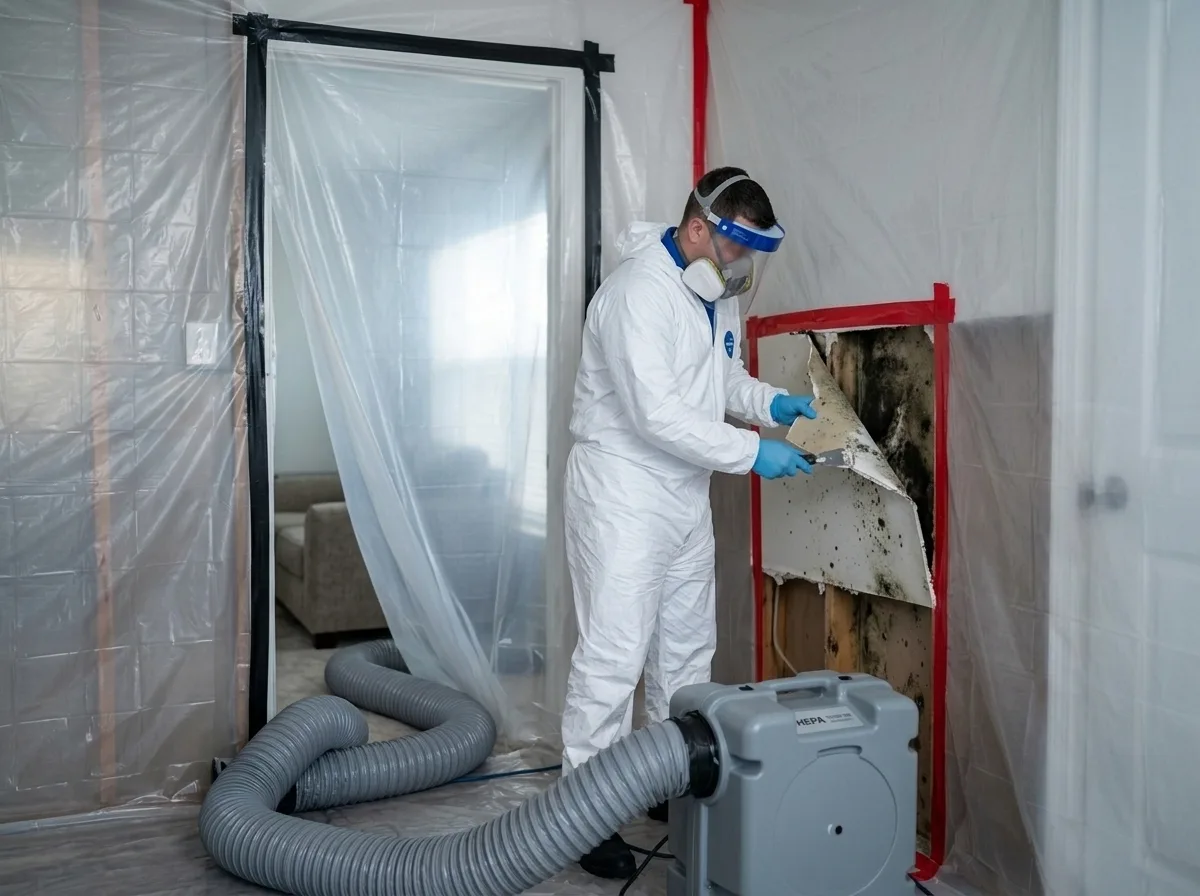
The work involves physical containment barriers (typically 6-mil poly sheeting with negative air pressure), HEPA-filtered air scrubbers running continuously during demolition, controlled removal of colonized drywall, insulation, or framing, and an antimicrobial treatment applied to remaining structural surfaces. Depending on the scope, the process can take two to five days before the space is ready for post-remediation clearance testing and reconstruction.
In Sacramento’s Central Valley climate, where summer humidity spikes follow irrigation season and winter condensation accumulates in poorly ventilated crawlspaces and attics, mold problems often concentrate in predictable locations: subfloor assemblies over damp soil, wall cavities behind shower surrounds, and attic sheathing under inadequately vented rooflines. Older Sacramento neighborhoods with original plaster-and-lath construction can mask moisture intrusion for months before mold becomes apparent at the surface.
Our process
1. Moisture source identification and scope assessment Before containment goes up, the source of moisture driving the mold growth has to be identified and stopped. Thermal imaging and moisture meters map the boundary of saturation, including areas that read dry at the surface but remain wet behind finishes. The remediation scope is written around confirmed affected materials, not a visual estimate.
2. Containment and negative air pressure The work area is isolated with poly sheeting barriers and zipper-door entry points. HEPA-filtered negative air machines draw air out of the containment zone and exhaust it outside, preventing spores disturbed during demolition from migrating to unaffected rooms. This step is non-negotiable on any job where mold is actively disturbed.
3. Controlled demolition and material removal Contaminated drywall, insulation, and, when colonization has penetrated deeply, framing members are removed inside the containment envelope. Materials are bagged and sealed before transport out of the work area. Structural wood with surface mold that has not compromised integrity is wire-brushed and HEPA-vacuumed rather than removed, then treated with an EPA-registered antimicrobial.
4. Antimicrobial treatment and HEPA vacuuming All remaining surfaces inside the containment zone are treated with an EPA-registered antimicrobial agent and allowed to dry. HEPA vacuuming follows to capture residual spore debris from framing, subfloor, and any mechanical components within the affected area.
5. Clearance testing An independent air quality test, collected after remediation and before reconstruction begins, confirms that airborne spore counts inside the remediated area are consistent with or below outdoor baseline levels. TDI USA, Inc. does not self-certify clearance; third-party sampling protects both the homeowner and the insurance record.
What separates a good mold remediation response from a bad one
The most common failure in mold remediation is inadequate containment, crews that skip negative air pressure or use insufficient barrier material end up redistributing spores to clean areas of the home during demolition. A secondary failure is stopping at visible mold without moisture mapping: if the wet zone extends beyond what’s been removed, regrowth is a matter of weeks.
Insurance adjusters reviewing mold claims look for documentation that the moisture source was identified and corrected, that affected materials were quantified by square footage, and that clearance testing was performed by a party independent of the contractor. Without that documentation chain, carriers have grounds to dispute the claim or deny coverage for recurrence.
Less experienced operators sometimes treat mold on framing with encapsulants and call it remediated. Encapsulation is a legitimate tool in specific circumstances, not a substitute for physical removal of heavily colonized material. The IICRC S520 standard provides the industry framework for when each approach is appropriate.
With 40+ years of construction and rebuilding experience, TDI USA, Inc. handles both the remediation and the post-remediation reconstruction under a single scope, which means no gap between the remediation contractor signing off and a separate rebuild contractor opening the walls again.
What does mold remediation cost?
Typical costs run from under $2,000 for a small, contained area to well over $30,000 when mold has spread through structural framing or HVAC systems. Most homeowners pay somewhere in the middle range for a bathroom, laundry room, or single wall cavity. The table below reflects typical industry figures, not a quote from TDI USA, Inc.
| Scenario | Typical industry range |
|---|---|
| Single bathroom or small area (under 10 sq ft) | $500 – $1,500 |
| Single room, limited structural involvement | $1,500 – $4,000 |
| Multiple rooms or wall cavities | $4,000 – $10,000 |
| Crawlspace or subfloor remediation | $3,000 – $12,000 |
| Attic mold (sheathing and rafters) | $2,500 – $8,000 |
| Whole-house or structural framing involvement | $15,000 – $35,000+ |
Every loss is different, and TDI USA, Inc. provides a written scope of work before any remediation begins. Homeowners insurance typically covers mold remediation when the mold is a direct result of a covered peril, a burst pipe, roof leak after a storm, but policies vary significantly on standalone mold coverage and dollar limits, so reviewing your declarations page before filing is worth the time.
Seasonal and regional considerations
Sacramento’s Mediterranean climate creates two distinct mold risk windows. The wet season, roughly November through March, brings sustained rain that can infiltrate aging roof assemblies, foundation walls, and window flashing on the region’s large stock of mid-century tract homes. Crawlspaces under homes built before modern vapor barrier requirements are especially vulnerable during prolonged wet stretches.
The second window is less obvious: late summer and early fall, when irrigation-heavy landscaping keeps soil moisture elevated and interior air conditioning creates cold surfaces where warm, humid air condenses inside wall cavities. Attic mold from inadequate ventilation tends to surface in late summer inspections, when the combination of heat and residual moisture has given colonies months to establish.
Service area
TDI USA, Inc. serves Sacramento and the surrounding region, including Elk Grove, Roseville, Folsom, Rancho Cordova, West Sacramento, Davis, Woodland, and communities throughout Sacramento, Placer, and Yolo counties. City-specific pages cover local permitting and housing considerations in more detail.
If you’re seeing signs of mold, discoloration, persistent musty odor, or a recent water event that wasn’t fully dried, call (877) 688-0866 to request an air quality assessment. The sooner the moisture boundary is mapped, the smaller the remediation scope tends to be.
Frequently Asked Questions
Does homeowners insurance cover mold remediation?
What level of mold contamination requires full containment with negative air pressure?
What is clearance testing, and why does it happen after remediation rather than before?
Can mold grow back after professional remediation?
How long does the mold remediation process take from start to clearance?
Looking for the best mold remediation company in Sacramento?
TDI USA, Inc. provides mold remediation in Sacramento, CA and the surrounding area, and has served local property owners since 1985. Customers rate us 5.0 out of 5 stars across 9 Google reviews. We answer calls 24/7 — call (877) 688-0866 for immediate help.
Need Mold Remediation now?
We respond 24/7 across Sacramento and surrounding CA cities.